Currently accepting same-day emergency patients across Louisville, KY. Average callback time is under 12 minutes.
Gum Disease Treatment in Louisville, KY: Bleeding Gums, Recession and Bone Loss
Where Louisville Goes to Stop Gum Disease Early
Emergency Dentists Louisville offers gum disease treatment for the entire Louisville area. If your gums bleed when you brush, look red or puffy, or seem to be pulling away from your teeth, you're in exactly the right place, and you're catching this at the right time.
Periodontal disease is an inflammatory disease driven by bacterial plaque that damages the gums, periodontal ligament, and bone supporting the teeth, and it's the leading cause of adult tooth loss. Gingivitis can often be reversed, while periodontitis can usually be controlled but the attachment and bone already lost may not fully return, and either way the next step is the same: get evaluated.
Tell us what's going on. We'll call you back fast.
We'll respond same-day. If you need to be seen right now, call us directly at 502-709-6108.
Our Periodontal Gum Disease Treatment Services
Our gum disease treatment in Louisville, KY uses scaling, root planing and ongoing periodontal maintenance to reduce inflammation, control infection, clean root surfaces, and slow or stop further periodontal attachment and bone loss that make periodontal disease the leading cause of adult tooth loss. We are the Louisville practice that measures your gums at every exam rather than only when they hurt, because painless gum disease is exactly the kind that costs people their teeth.
Signs You May Have Gum Disease
Gum disease announces itself quietly. Schedule an evaluation if you notice any of the following:
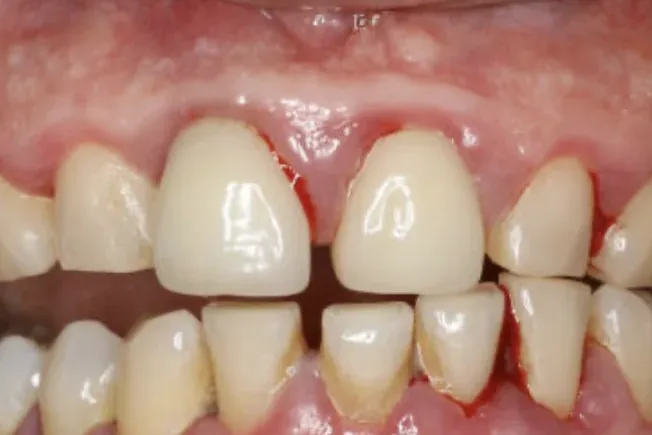
Gums that bleed when you brush or floss
Red, swollen, or tender gums
Bad breath or a bad taste that won't go away
Gums pulling away from the teeth, or teeth that look longer than they used to
Loose or shifting teeth, or a change in how your bite fits together
Pus or drainage between the teeth and gums
The quiet-disease warning: many people with gum disease have no obvious symptoms at all, which is why gum measurements are part of every exam here and why "it doesn't hurt" is never proof that everything's fine. Pus, significant swelling, or pain can signal a gum abscess needing same-day care: see our dental abscess treatment page, and call 502-709-6108 to be seen fast.
From Gingivitis to Periodontitis: How Gum Disease Progresses
Gum disease starts with plaque, the sticky bacterial film that forms on teeth every day. When plaque isn't fully removed, it hardens into tartar, spreads below the gumline, and the infection progresses through three stages:
1. Gingivitis
Red, swollen gums that bleed easily, usually with little or no pain. This is the reversible stage: professional cleaning and consistent plaque control can often resolve gingival inflammation when there is no attachment or bone loss.
2. Periodontitis
The infection moves below the gumline. Gums separate from the teeth, forming infected pockets, and the bone supporting your teeth begins to break down. Periodontitis can often be stabilized with treatment and maintenance, although lost attachment and bone do not simply grow back on their own.
3. Advanced Periodontitis
Pockets deepen, bone loss accelerates, and teeth loosen, shift, or are lost. Treatment now often requires surgical care to save what remains.
Smoking, diabetes, hormonal changes, dry mouth, certain medications, crowded teeth, and genetics all raise your risk, and roughly half of American adults over 30 have some form of gum disease. Whatever your stage, the math never changes: treating it today is easier, cheaper, and more successful than next year.
"My Gums Only Bleed a Little. Is That Really a Disease?"
Yes, and this deserves a direct answer because it's the belief that lets gum disease win. Healthy gums don't bleed. Bleeding when you brush or floss isn't a sign you brushed too hard, it's inflammation responding to bacterial infection at the gumline, and it's the earliest, most treatable signal you'll ever get. People wait because gum disease is nearly painless while it works: no toothache, no emergency, just a little pink in the sink while the bone under your teeth quietly erodes. By the time teeth feel loose, the cheap, reversible window closed years earlier.
The encouraging flip side: caught at the gingivitis stage, gum disease is fully reversible, often with nothing more than a professional cleaning and better home habits, and at the periodontitis stage it's still very manageable without surgery. If your gums bleed, you don't have a brushing problem. You have a solvable gum problem, and you're one evaluation away from the plan.
How We Diagnose Gum Disease
Diagnosis is quick, painless, and precise. We examine your gums for redness, swelling, and recession, then gently measure the pocket depth around each tooth with a small probe: healthy pockets run 1 to 3 millimeters, and deeper pockets map exactly where disease is active. Digital X-rays show the bone level around your teeth, and your medical history fills in risk factors like diabetes or medications. You leave the exam knowing precisely what stage you're in and what it takes to fix, nothing sugarcoated, nothing exaggerated.
How We Treat Gum Disease, Stage by Stage
Our philosophy is conservative: the least invasive treatment that will genuinely work, with surgery reserved for cases that truly need it. Treatment is matched to your stage:
Professional Cleaning + Home Care Reset (Gingivitis)
A thorough cleaning removes the plaque and tartar driving the inflammation, and we coach you on the brushing, flossing, and antimicrobial rinse routine that keeps it gone. Our teeth cleanings page covers what that visit looks like. For early gum disease, this is often the entire cure.
Scaling and Root Planing (Periodontitis)
The workhorse of non-surgical gum therapy, also called a deep cleaning. With the area comfortably numbed, we clean bacteria and tartar from below the gumline, then remove plaque and calculus from below the gumline and debride contaminated root surfaces so inflammation can resolve and the tissues can heal more tightly around the teeth. It's typically done by quadrant across one or two visits, and it stops most periodontitis in its tracks.
Antibiotic and Laser Therapy
Where infection lingers, topical or oral antibiotics target the remaining bacteria, and soft-tissue laser therapy can gently disinfect pockets and remove inflamed tissue with less bleeding and faster healing.
Surgical Care (Advanced Periodontitis)
Deep pockets and significant bone loss may call for pocket reduction surgery, gum grafting, bone grafting, or guided tissue regeneration. When your case needs a periodontal specialist's care, we'll tell you honestly and take care of that step for you, then handle your ongoing maintenance here at home.
Your Gums and Your Health (and Keeping Both)
Periodontal disease is associated with several systemic health conditions, including diabetes and cardiovascular disease, but association does not mean that gum disease directly causes each condition. Its bacteria and chronic inflammation can enter the bloodstream, and research links untreated periodontal disease to higher risks of heart disease, stroke, diabetes complications, respiratory infections, and pregnancy complications. Treating your gums is an investment in your overall health, which is also why most insurance plans cover scaling and root planing and periodontal maintenance as necessary care. We verify your benefits and put the estimate in writing first.
One honest expectation: after periodontitis, treatment shifts from cure to control. periodontal maintenance is commonly scheduled more frequently than routine preventive cleanings because patients with periodontitis remain at higher risk for recurrence, so patients with a gum disease history move to maintenance cleanings every 3 to 4 months instead of every 6. Patients who keep that schedule routinely keep their teeth for life; patients who drift back to "when I get around to it" end up on our tooth replacement pages. That short visit is the single best predictor of how this story ends.
Why Choose Emergency Dentists Louisville
Gum measurements at every exam, so disease gets caught in the reversible stage instead of the expensive one.
Conservative, non-surgical-first treatment, with numbing for every deep cleaning and surgery only when truly needed.
Judgment-free care, whether it's been six months or sixteen years since your last cleaning.
Written estimates and verified insurance benefits before any treatment begins.
Frequently Asked Questions
Can gum disease be reversed?
Yes, at the gingivitis stage gum disease is fully reversible with professional cleaning and consistent home care. At the periodontitis stage the damage can be stopped and managed very successfully, but lost bone doesn't grow back on its own.
Does a deep cleaning (scaling and root planing) hurt?
No, the treated areas are numbed first, so you feel pressure rather than pain. Some gum tenderness and sensitivity for a few days afterward is normal and fades as your gums heal.
What happens if I don't treat my gum disease?
It progresses: pockets deepen, the bone anchoring your teeth erodes, and teeth loosen and are eventually lost. Untreated gum disease is also linked to higher risks of heart disease, stroke, and diabetes complications.
Is gum disease contagious?
The disease itself isn't contagious, but the bacteria behind it can pass through saliva, so avoid sharing utensils or toothbrushes if you have active gum disease. Good hygiene for the whole household is the practical defense.
How often will I need cleanings after gum disease treatment?
Most patients with a history of gum disease do best with periodontal maintenance visits every 3 to 4 months. Bacteria repopulate below the gumline within a few months, and that schedule keeps them from ever regaining a foothold.
Bleeding Gums Are the Warning. This Is the Response.
One evaluation tells you your exact stage and your exact plan. Catch it while it's still the easy version of this problem.