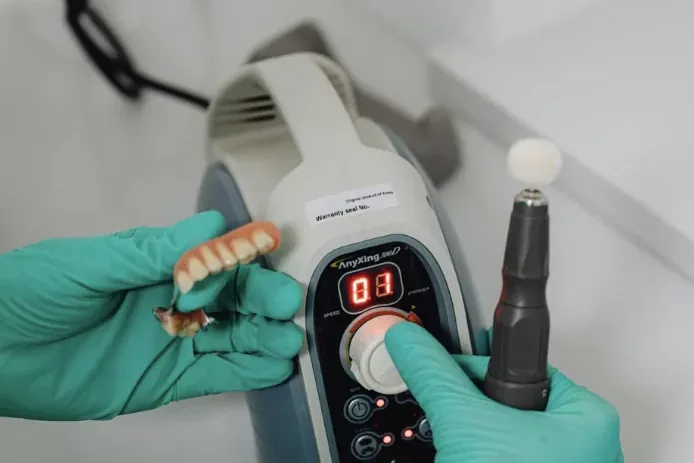
Emergency Dentists Louisville offers dentures for the entire Louisville area. Whether you're missing a few teeth or an entire row, we custom-fit full, partial, immediate, and implant-supported dentures that look natural and let you eat, speak, and smile with confidence again.
If you're living with missing teeth or an old set of dentures that no longer fits, you're in the right place. Every set we make is designed for your mouth, not pulled off a shelf.
Tell us what's going on. We'll call you back fast.
We'll respond same-day. If you need to be seen right now, call us directly at 502-709-6108.
Our dentures in Louisville, KY are custom-molded from impressions of your own mouth in full, partial, immediate and implant-supported designs, designed around your bite, gum tissues, residual ridge, facial support, and comfort so the denture functions as predictably as possible. We are the Louisville practice that spends the time on the fitting appointments rather than the lab invoice, and we repair and reline dentures the same day when they break.
Dentures are removable replacement teeth that fill the gaps left by missing teeth. A full (or complete) denture replaces an entire row of teeth on the upper or lower jaw, while a partial denture fills in around the natural teeth you still have. Dentures are made from impressions or digital records of your mouth, bite records, tooth selections, and clinical measurements, then adjusted for fit and function, so they fit more securely and look far more natural than older versions.
Beyond the smile, replacing missing teeth matters for function: gaps make it harder to chew and speak, and over time tooth loss is followed by gradual resorption of the supporting jawbone, which can change denture fit and facial support over time. Roughly 1 in 5 adults aged 65 and older have lost all their natural teeth, so if you're facing this, you're far from alone.
The right denture depends on how many teeth you're replacing and whether you want a removable or implant-anchored option. We'll walk you through which fits your situation at your consultation.
Replace all teeth in an upper or lower arch. Conventional dentures are usually made after healing, while immediate dentures can be placed at the time of extraction.
Fill in a few missing teeth using a framework that attaches to your remaining natural teeth for support.
Placed the same day teeth are removed so you're never without teeth, then adjusted once your gums have healed.
Use dental implants for added retention or support and may be removable by the patient or fixed, depending on the design instead of resting on the gums, for a far more stable, secure hold.
Dentures may be the right solution if you're dealing with any of the following:
Some patients with only a few missing teeth may be better suited for implants or a bridge, and some may need gum disease treatment or extractions handled first. We'll give you an honest assessment of which option actually fits, not just push the most expensive one.
Getting fitted for dentures happens in stages, and knowing them upfront takes the mystery out of it.
We examine your mouth, take X-rays, and take impressions or digital records and record how the upper and lower jaws meet so the denture can be designed for your bite.
Any teeth that can't be saved are removed to make room. You'll help choose the size and shade of your new teeth.
A dental lab builds your custom set from resin or porcelain, sized and shaded to look like natural teeth.
You try them on and we fine-tune the fit. As gums settle after tooth loss, a follow-up adjustment or reline is normal.
Good care keeps dentures comfortable and extends their life. A few rules matter more than the rest:
With proper care, most dentures last five to ten years. Because your jawbone and gums slowly change shape after tooth loss, even a well-made set will eventually need a reline or replacement, which is normal and not a sign anything went wrong.
Denture cost depends on the type you choose, the materials, and whether extractions or other prep work are needed first. A basic partial and a full implant-supported set sit at very different price points, so we give you a clear estimate after your consultation rather than a number over the phone.
Many dental plans provide some denture benefits, but coverage, replacement frequency, deductibles, and annual maximums vary of dentures, since they're considered a restorative rather than purely cosmetic treatment. We'll review your specific plan with you and offer financing options so cost doesn't keep you from getting your smile back.
If you have several missing or failing teeth, constant tooth pain, or difficulty eating, dentures may be a good fit. The only way to know for sure is an exam, which we offer as a free consultation.
Most patients can return to a broad diet with well-fitting dentures, but chewing efficiency is different from natural teeth and adaptation takes time. Start with soft foods and gradually add firmer ones. Avoid very sticky or hard foods like caramels, ice, and nuts, which can dislodge or damage them.
There's usually an adjustment period where new dentures feel awkward or cause minor soreness, but that eases as you get used to them and we fine-tune the fit.
Most dentures last five to ten years with proper care. Because your gums and jaw change shape over time, an occasional reline or replacement is normal.
Many plans cover some or all of the cost, since dentures are considered restorative. We'll review your specific coverage and offer financing if needed.
Whether you need a first set, a replacement, or a fast repair, our team makes the whole process straightforward. Book a free consultation today.
Call 502-709-6108